
Introduction
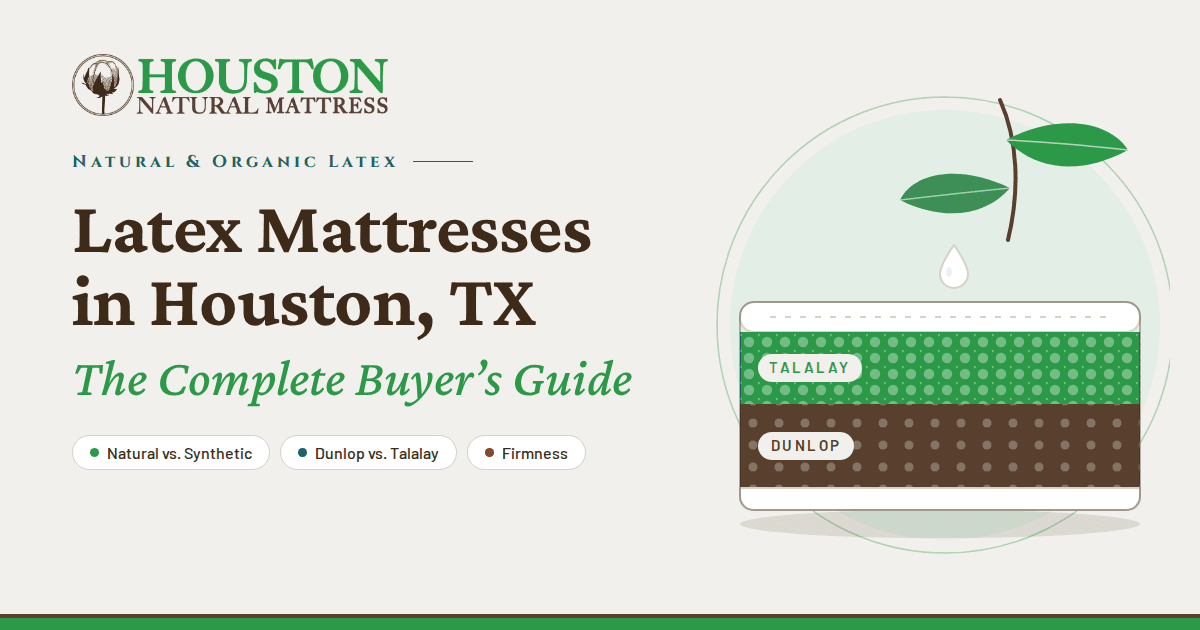
A latex mattress can be an excellent choice for a Houston bedroom, but it is also one of the easiest mattress categories to misunderstand at the point of sale. After years of helping Houston sleepers, the question we hear most is whether all latex mattresses are the same. They are not. The word “latex” on a tag can mean a number of different things. It could mean foam made with natural rubber derived from rubber trees, or synthetic rubber made from petrochemicals, and those materials can differ substantially in price, feel, and performance. On top of that sit two processing names, Dunlop and Talalay, plus a certification question that trips up even careful shoppers.
While this might feel confusing at first, itis simple once you lay the pieces out. At Houston Natural Mattress on Kirby Drive, we carry one of the largest selections of natural and organic latex mattresses in Texas, so you can test a variety side by side.
Quick Answer
A latex mattress contains latex foam made from natural rubber, synthetic rubber, or a blend of the two, prized for being breathable, responsive, and long-lasting. The single most important thing to verify is the composition: natural latex uses rubber derived from rubber trees, synthetic uses rubber manufactured from petrochemicals, and blended combines the two. Separately, that latex can be made by one of two processes, Dunlop or Talalay, which shape how it feels. If certified organic content matters to you, note that latex certified to GOLS (the Global Organic Latex Standard) is currently produced using the Dunlop process.
Key Takeaways
- Composition matters most. Natural latex uses rubber derived from rubber trees. Synthetic uses rubber manufactured from petrochemicals. Blended combines the two. High-quality natural latex is valued for resilience and breathability, but synthetic and blended formulations vary widely, so always ask which one you are buying and request documentation.
- Dunlop and Talalay are processes, not brands. Both can be natural latex from the same rubber. Dunlop typically feels denser and firmer; Talalay typically feels lighter and more buoyant. Many good mattresses use both.
- GOLS-certified latex is currently Dunlop. Talalay can be made with 100% natural rubber, but no GOLS-certified Talalay is currently available. If certified organic latex is your priority, you are looking at Dunlop.
- Latex suits Houston. Its open structure breathes and sheds heat, which many hot sleepers prefer over dense memory foam. That advantage matters in a hot, humid climate.
- The ability to compare matters. The right latex mattress depends on your body, your sleep position, and your priorities. A store that carries natural Talalay, organic Dunlop, and latex toppers under one roof lets you compare feels instead of settling for whatever one line a shop happens to stock.
The Three Types of Latex
Before you ever get to Dunlop versus Talalay, settle the more basic question: is the latex natural, synthetic, or blended? This is one of the biggest predictors of how a mattress will feel and last.
- Natural latex is made from rubber derived from rubber trees, cured into foam with only small amounts of curing agents. It is valued for resilience, breathability, and long-term performance, and it is usually the most expensive.
- Synthetic latex is made from petroleum-based styrene-butadiene rubber, engineered to mimic natural latex at lower cost.
- Blended latex combines the two. The ratio varies by manufacturer, so two blended beds can feel and perform quite differently.
Composition alone does not predict exactly how long a mattress will last, because durability also depends on density, construction, use, and manufacturer quality.
The practical rule: do not assume the word “latex” means natural or organic. If the composition is not clearly disclosed, ask what percentage of the rubber polymer is natural, and request documentation. The price gap between synthetic and quality natural latex is large, so it is worth knowing exactly what you are paying for.
How Latex Is Made: Dunlop vs. Talalay
Composition tells you what the latex is; Dunlop and Talalay describe how it is processed. Do not use the process name alone to determine whether the latex is natural, blended, or synthetic. Both processes start the same way, with liquid latex mixed with curing agents and whipped into a froth. From there they split.
The Dunlop method, in use since the late 1920s, is the simpler one. The frothed latex is poured into a mold, baked until solid, then washed and dried. Because the mixture settles as it bakes, Dunlop is slightly denser at the bottom than the top, which gives it a firm, stable, substantial feel.
The Talalay method adds two steps. After the latex is poured, the mold is sealed and placed under vacuum, which expands the latex into a lighter foam and fills the mold evenly. It is then flash-frozen to lock the cell structure in place before baking. The result is more uniform top to bottom and more open in structure, so Talalay tends to feel buoyant and sleep cool. It also costs more to make.
| Talalay latex | Dunlop latex | |
| Process | Vacuum-sealed, flash-frozen, then baked | Poured and baked, the original method |
| Typical feel | More buoyant and lively | More substantial and grounded |
| Consistency | Uniform top to bottom | Slightly denser at the bottom |
| Breathability | Very open structure, often sleeps cooler | Breathable, though denser |
| Commonly used in | Comfort and pressure-relief layers | Support cores and firmer comfort layers |
| Organic certification | No GOLS-certified Talalay currently available | GOLS-certified organic latex is commonly made this way |
One caution: the common belief that Talalay is always softer than Dunlop is not true. Both can be engineered soft or firm, so judge feel in person rather than from the process name on the label.
Understanding Firmness and ILD
Latex firmness is measured in ILD, or Indentation Load Deflection. Think of ILD as a mattress firmness score: a lower number means a softer feel, and a higher number means a firmer feel. The number matters because latex often comes in layers, and a well-built bed lets you choose the firmness of each layer rather than committing to one feel for the whole mattress.
Firmness should follow how you sleep and what you weigh. Softer surfaces let a side sleeper’s shoulders and hips sink in for pressure relief; firmer ones keep a back or stomach sleeper’s spine aligned. Body weight shifts the target too: a lighter person and a heavier person need different ILDs to get the same feel. That is the case for the customizable, layered beds we carry, which tend to satisfy more people than a single fixed firmness. If you are not ready to replace a whole mattress, a latex mattress topper can change the feel of the bed you already own, and the same Dunlop-versus-Talalay logic applies to choosing a topper.
The Certification Question
If organic content is a priority, GOLS is the standard to know for organic natural-rubber latex. GOTS, the Global Organic Textile Standard, is the separate standard relevant to organic textiles and finished-product certification. GOLS-certified latex is currently produced using the Dunlop process. Talalay can be made with 100% natural rubber, but no GOLS-certified Talalay is currently available.
This does not make Talalay bad. All-natural Talalay uses a natural-rubber formulation without synthetic rubber, but it is not currently offered with GOLS certification. If you want GOLS-certified organic latex, you are looking at a Dunlop-based mattress. If you want the buoyant, breathable Talalay feel, all-natural Talalay gives you a natural-rubber material without that certificate. Both are legitimate; they answer different priorities. For what certification proves, see our guide to what an organic mattress actually is.
Why Latex Suits Houston
Houston sleepers who tend to overheat may find dense memory foam less comfortable, because it can retain more body heat around the sleeper. Latex is generally more responsive and breathable: its open structure moves air rather than holding it, so it sheds body heat instead of building it up.
For most Houston sleepers who run warm, this is where we would point you toward latex, and toward Talalay in the comfort layer for its extra breathability. The honest exception: if you love the deep, slow-sinking hug of memory foam and sleep cool enough already, latex will feel too springy, and no amount of breathability will change that. Bedding, room temperature, and your own physiology still shape how warm any bed sleeps, but for a hot Houston bedroom, the material under you is a good place to start.
Common Questions About Latex Mattresses
Is a latex mattress worth it? For many sleepers who want a durable, breathable, responsive bed, yes. Quality natural latex is known for resilience and tends to sleep cool. The tradeoffs are a higher upfront cost and a springy feel that some memory-foam fans dislike.
Natural, blended, or synthetic latex, which should I buy? High-quality natural latex holds up well over time and breathes better than synthetic, and it is usually the most expensive. Blended and synthetic vary considerably by manufacturer and are generally cheaper. If long-term performance is a priority, quality natural latex is often the better value, but composition alone does not settle it; ask for the specifics.
Can a latex mattress be certified organic? A mattress may use GOLS-certified organic latex and organic textile materials without the complete mattress carrying finished-product certification. Ask to see documentation for the exact mattress model and confirm whether the certificate covers the complete product or only a named material. Note also that GOLS-certified latex is currently Dunlop, not Talalay.
Where can I try a latex mattress in Houston? At Houston Natural Mattress on Kirby Drive, near Rice Village and the Museum District. We carry all-natural (in Talalay) and organic latex (in Dunlop), so you can compare feels in one visit.
Buyer’s Checklist for a Latex Mattress
- Know the composition. Natural, blended, or synthetic, and the percentage if it is blended.
- Verify the claim. A “100% natural” or GOLS claim should be backed by documentation, not just the word “latex.”
- Identify the process. Know whether the latex is Dunlop, Talalay, or a combination, and which layers are which.
- Decide on organic. Settle whether certified organic content matters to you, knowing that requires Dunlop.
- Match the firmness. Fit it to your sleep position and body weight, felt in person rather than assumed.
- Check the layers. If the bed is layered, make sure the comfort you are paying for is in the layer you sleep on.
- Ask the store. They should be able to tell you the source, composition, and process of the latex, not just that it is “latex.”
Try One of Texas’s Largest Latex Selections in Person
At Houston Natural Mattress, we carry natural and organic latex across our lines, so you can compare side by side from trusted brands such as Naturepedic, Avocado Green, and The Natural Mattress Home. We can show you the certification documents for each mattress so you can see exactly what they cover.
Serving the Greater Houston Metro, including the Heights, Rice Village, River Oaks, Upper Kirby, Montrose, the Museum District, and beyond. Visit our Kirby Drive showroom and feel the difference for yourself.
Address: 6111 Kirby Dr, Houston, TX 77005
Phone: (832) 582-6324
Website: houstonnaturalmattress-opti.blz.au
Hours:
Mon: 10 AM – 7 PM
Tue: 10 AM – 7 PM
Wed: 10 AM – 7 PM
Thu: 10 AM – 7 PM
Fri: 10 AM – 7 PM
Sat: 10 AM – 5 PM
Sun: 12 PM – 6 PM
Amanda Demuth, MSN, RN · Wellness Advisor, Houston Natural Mattress
Amanda is a wellness-focused writer passionate about sustainable living and sleep science. She specializes in natural mattresses and eco-conscious bedding, exploring how healthier materials and mindful choices can transform the way we rest. With a graduate degree in Nursing from Vanderbilt University and professional membership in the American College of Lifestyle Medicine, Amanda strives to promote the pillars of restorative sleep and the avoidance of toxic substances. She empowers readers to make informed decisions that benefit both personal well-being and the planet. Outside of her research on organic sleep solutions, Amanda enjoys forest hikes, sipping herbal tea, and embracing minimalist design.