
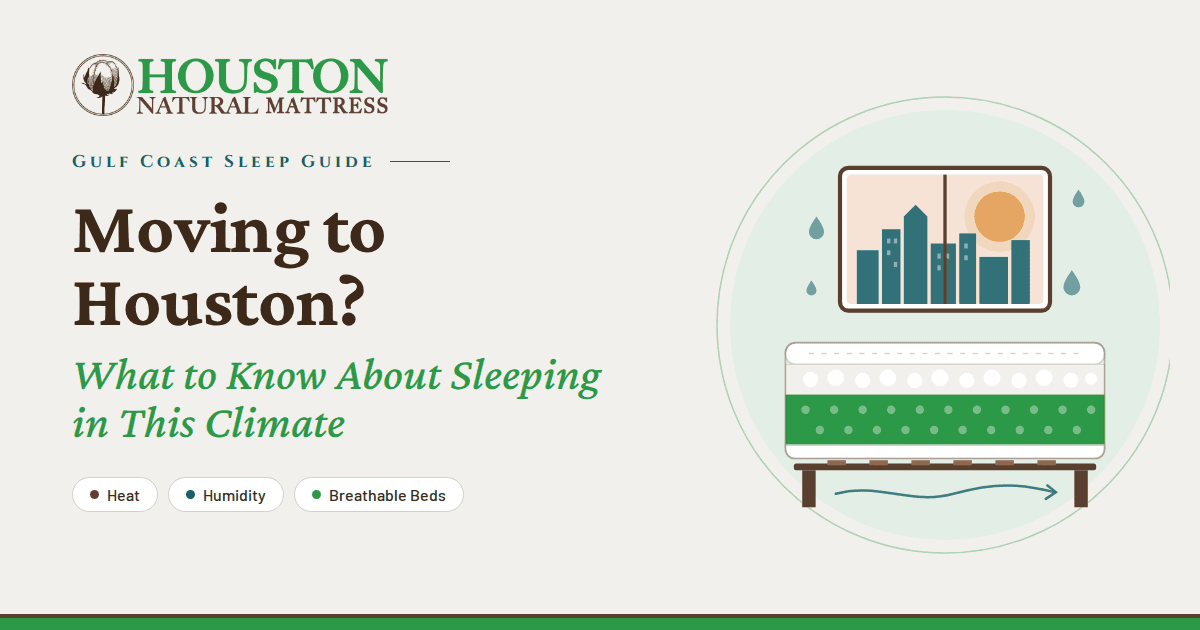
How Houston’s heat and year-round humidity affect your sleep and your mattress, and what to look for in a bed built for the Gulf Coast.
Introduction
If you have just moved to Houston, you have already felt the thing that no relocation guide quite prepares you for: the air. Step off a plane here after time in a drier place and the humidity presses in from all sides. It is not your imagination, and it does not always stop at the front door, especially when a home’s air conditioning and ventilation are not controlling indoor moisture well. Houston’s climate changes how you sleep and how your mattress holds up over time, in ways newcomers rarely anticipate until a few muggy nights in.
The good news is that this is manageable, and much of it comes down to the bed you sleep on and how you set it up. Here is what a Houston bedroom asks of a mattress, and how to choose one that works with the Gulf Coast rather than against it.
Quick Answer
Houston is hot and humid for much of the year, which means two things for sleep: you will fight overheating at night, and moisture becomes a year-round consideration for your mattress. The bed that tends to serve you best here is breathable rather than heat-trapping, which favors ventilated latex, wool, and breathable cotton covers over dense memory foam. Just as important is the setup: a foundation that lets air move under the mattress, a breathable protector, and indoor humidity kept in a healthy range all help you sleep cooler and keep your mattress fresh.
Key Takeaways
- Humidity is not just a summer problem. Houston’s mornings average close to 90% relative humidity across the year, while summer heat routinely reaches the 90s. Indoor humidity control matters in every season.
- Heat-trapping beds work against you. Dense memory foam tends to hold body heat, which is a real drawback on a warm, humid Houston night.
- Breathable construction matters. Ventilated latex, moisture-managing wool, and breathable cotton covers can allow better airflow than deeply conforming, dense foam, though the complete build matters more than any one material.
- Setup matters as much as the mattress. A slatted or ventilated foundation, a breathable protector, and controlled indoor humidity protect both your sleep and your bed.
- Moisture control supports a healthier bedroom. Warm, damp conditions can encourage mold and dust mites, so indoor humidity, airflow, and regular cleaning matter, especially for allergy-prone households.
Why Houston Feels Different at Night
Houston sits in a subtropical, Gulf Coast climate, and what sets it apart is not just heat or just humidity but the two together, for most of the year. The humidity is easy to misread from a single number, because it swings through the day: NOAA data show average morning relative humidity near 90% across the year, even though afternoon readings fall as temperatures rise. Summer mornings run higher still, into the low 90s, while summer highs routinely reach the 90s with lows only in the mid-70s. The practical upshot is that the moisture is heaviest overnight and in the early morning, exactly when you are asleep.
The part newcomers underestimate is the calendar. In much of the country, cold, dry winters interrupt the damp season and give homes a natural reset. Houston’s mild winters do not. Warmth and moisture linger across the year, so managing indoor air here is closer to a year-round job than a summer chore. That reality shapes both how comfortable you are at night and how a mattress ages.
Why Breathable Construction Matters Here
Overheating is the most immediate sleep problem a Houston bedroom creates. When the air is warm and heavy, a mattress that holds heat turns the night into a slow build of trapped warmth against your body. Dense memory foam is the classic example: it softens with body heat and tends to hold that warmth as the night goes on.
Breathable construction does the opposite. Mattresses built with ventilated latex, moisture-managing wool, and breathable cotton covers can allow better airflow than deeply conforming, dense foam, so they tend to run cooler through a warm night. Judge the complete mattress, though, because quilting, protectors, bedding, mattress depth, and foam design all influence how warm a bed feels. No single material guarantees a cool night on its own.
Protecting a Mattress in a Humid Climate
Choosing the right materials is half the job. The other half is setup, and it matters more here than almost anywhere.
- Give it airflow underneath. A slatted or ventilated foundation lets moisture escape rather than collecting between the mattress and a solid base. Avoid putting a mattress flat on the floor.
- Choose the right protector. Look for a waterproof protector designed for airflow and moisture-vapor transfer. Some heavy, impermeable protectors can make a bed feel warmer, so consider the whole protector construction rather than the word “waterproof” alone.
- Manage indoor humidity. Keeping your bedroom in a healthy relative-humidity range, roughly 30 to 50%, discourages mold and dust mites. A small hygrometer gives you a constant readout, and your air conditioning does much of the work. If the bedroom regularly stays above 60% despite running the air conditioner, the fix may be a dehumidifier or an HVAC evaluation rather than a new mattress.
- Let it breathe. Pulling back heavy bedding while you are out lets the surface dry, and the occasional airing helps in a climate this damp.
A breathable mattress, adequate ventilation, and effective indoor humidity control all work in the same direction.
Common Questions About Sleeping in Houston
Does humidity really affect a mattress? Yes. Trapped moisture in a humid climate can encourage mold and dust mites over time, especially with poor airflow beneath the bed. Controlled indoor humidity and a ventilated foundation are the main defenses.
What is the best mattress material for Houston’s heat? Breathable construction is what matters most: ventilated latex, moisture-managing wool, and breathable cotton covers tend to run cooler than dense memory foam, which holds heat on a warm night. The complete build, including quilting and cover, matters more than any single material.
Will a latex mattress get moldy in Houston? Any mattress can develop moisture problems if it stays damp or lacks airflow. A ventilated foundation, controlled indoor humidity, a suitable protector, and regular care matter more than relying on the mattress material alone.
I sleep hot since moving here. Is it the mattress? It can be a large part of it. A heat-trapping mattress makes a warm, humid climate worse, while a breathable one works with your air conditioning. Bedding and room temperature play a role too, but the bed itself is the first thing worth checking.
A Houston Sleep-Setup Checklist
- Favor breathable construction. Ventilated latex, moisture-managing wool, and breathable cotton covers over dense, heat-trapping foam.
- Ventilate underneath. Use a slatted or ventilated foundation, and keep the mattress off the floor.
- Choose the right protector. Waterproof but designed for airflow and moisture-vapor transfer, not a heavy, impermeable one.
- Watch indoor humidity. Aim for roughly 30 to 50% with your air conditioning and, if needed, a small dehumidifier.
- Air the bed. Let the surface dry regularly in a climate this damp.
New to Houston? Come Find Your Climate-Right Bed
Adjusting to Houston takes a season, and your bed should make it easier, not harder. At Houston Natural Mattress on Kirby Drive, we offer a carefully selected range of natural, organic, latex, and luxury mattresses, chosen for breathable comfort, lasting support, and Houston’s warm, humid climate. Come tell us how you sleep and where you are settling in, and we will help you find a bed well suited to life on the Gulf Coast.
Serving the Greater Houston Metro, including the Heights, Rice Village, River Oaks, Upper Kirby, Montrose, the Museum District, and beyond. Visit our Kirby Drive showroom and feel the difference for yourself.
Address: 6111 Kirby Dr, Houston, TX 77005
Phone: (832) 582-6324
Website: houstonnaturalmattress-opti.blz.au
Hours:
Mon: 10 AM – 7 PM
Tue: 10 AM – 7 PM
Wed: 10 AM – 7 PM
Thu: 10 AM – 7 PM
Fri: 10 AM – 7 PM
Sat: 10 AM – 5 PM
Sun: 12 PM – 6 PM
Amanda Demuth, MSN, RN · Wellness Advisor, Houston Natural Mattress · Member, American College of Lifestyle Medicine

Amanda is a wellness-focused writer passionate about sustainable living and sleep science. She specializes in natural mattresses and eco-conscious bedding, exploring how healthier materials and mindful choices can transform the way we rest. With a graduate degree in Nursing from Vanderbilt University and professional membership in the American College of Lifestyle Medicine, Amanda strives to promote the pillars of restorative sleep and the avoidance of toxic substances. She empowers readers to make informed decisions that benefit both personal well-being and the planet. Outside of her research on organic sleep solutions, Amanda enjoys forest hikes, sipping herbal tea, and embracing minimalist design.