
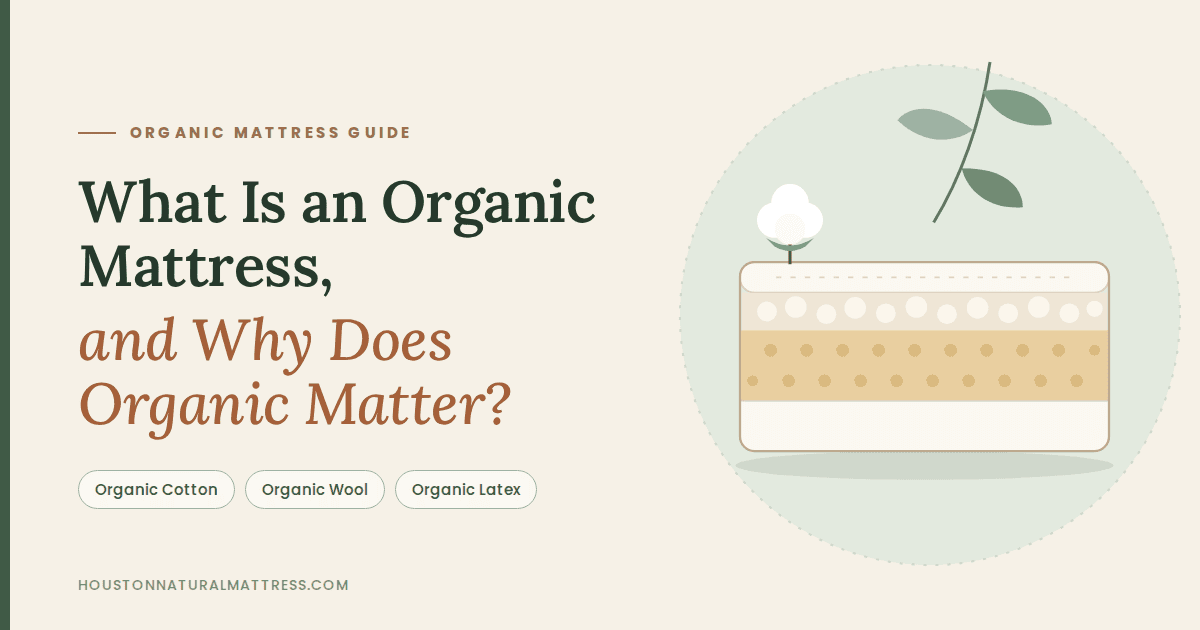
What the word “organic” actually means on a mattress, which certifications prove it, and why it matters in a Houston bedroom.
Introduction
If it has been years since you last shopped for a mattress, the store floor has changed under you. Words that were not there last time are everywhere now: organic, natural, non-toxic, plant-based, GOTS, GOLS. Some of them are backed by something real. Some are marketing. From the showroom floor, they are almost impossible to tell apart, and the salesperson is not always the person to ask.
Organic is the one worth understanding first, because it is the claim with the most behind it and the most riding on it. A mattress is an object that can affect your overall health. You spend about a third of your life lying on it. If it is uncomfortable you do not rest well, and night after night you are breathing the air just above it. What your mattress is made of can affect that air, which is why it is worth knowing what the word “organic” actually promises, what proves it, and what it means for your sleeping environment.
Quick Answer
An organic mattress is built from certified organic materials: organic latex, organic cotton, and organic wool. Independent standards verify them, chiefly the Global Organic Textile Standard (GOTS) for textiles and the Global Organic Latex Standard (GOLS) for latex. Because you spend about a third of your life on your mattress, certified organic materials can reduce reliance on synthetic materials and added flame-retardant treatments. Separate low-emission certifications verify what the mattress releases into indoor air.
Key Takeaways
- A credible organic claim should be certified. GOTS and GOLS documentation is what allows a shopper to verify what is organic and what the certification actually covers, because no federal label defines “organic” for a whole mattress.
- It is about what you breathe and touch. Certified organic materials cut down on synthetic components and added flame retardants, while separate low-emission certifications verify what a mattress releases into the air, including volatile organic compounds (VOCs).
- Wool can replace added chemical flame retardants. Many certified organic mattresses use wool as part of an engineered flame-barrier system, letting the finished bed pass federal flammability testing without fiberglass or added chemical flame retardants.
- Houston makes it matter more. Homes here stay closed and air conditioned for much of the year, making verified low emissions and good ventilation especially relevant.
Why Organic Matters
The case for an organic mattress comes down to what the materials are and what they do in the room.
Some foams, adhesives, fabrics, and other mattress materials can release VOCs into the surrounding air. This process, called mattress off-gassing, is strongest when materials are new but can continue over time. Low-emission certifications test a product or component against defined emissions limits, while organic certifications verify the origin and processing of agricultural materials.
The flame barrier is one example. Federal law requires every mattress to pass flammability testing, but it does not say how. That is a performance standard, not a recipe, and a properly engineered wool barrier can carry a finished bed through the same test without fiberglass or added chemical flame retardants.
Beyond the bedroom, organic farming restricts most synthetic pesticides and fertilizers, which is better for the soil, the water, and the people who grow the materials. Quality natural latex is also exceptionally durable, though how long any mattress lasts depends on its construction, foundation, and use.
What Makes a Mattress Organic
Three materials do most of the work. Organic latex comes from the sap of the rubber tree, certified under GOLS. Organic cotton forms the cover, and in some beds part of the fill, certified under GOTS. Organic wool is used as cushioning and, just as important, as part of the flame barrier, also certified under GOTS.
A word of caution before you shop: because no federal rule defines “organic” for a whole mattress, some sellers use the word loosely, pairing it with self-made seals or a single organic component to imply far more than the bed delivers. This is greenwashing, and it is common enough to plan around. For how to spot it, see our guide to the dangers of greenwashing.
The Certifications That Carry Weight
Each of these answers a different question, and no single one answers them all. Before the names, one distinction matters more than any of them. For the full breakdown, see our guide to organic and chemical-free certifications.
A certificate can cover one component, such as the cotton in the cover or the latex in the core, or the finished mattress as a whole. The finished-mattress certificate is a far higher bar, because every material in the product then has to meet the standard. A mattress may contain textiles supplied through a GOTS-certified supply chain or latex certified under GOLS without the finished mattress itself being certified. Ask to see the certificate for the exact mattress model, including the certification body and certification number. Certification of an individual material should not be presented as certification of the complete mattress, which is the difference between a mattress made with organic cotton and one that is certified organic.
| Certification | What it confirms |
| GOTS | Global Organic Textile Standard. Covers organic cotton and wool, including processing chemicals and supply chain social criteria. The “organic” grade requires at least ninety-five percent certified organic fibers. On a finished mattress, GOTS prohibits polyurethane foam of any kind, memory foam included. |
| GOLS | Global Organic Latex Standard. Verifies organic latex and its chain of custody, and requires at least ninety-five percent certified organic natural rubber latex. Synthetic latex is prohibited outright. It is what proves the latex in a mattress is organic. |
| The four below are not organic certifications. They confirm emissions or material safety, and a mattress can carry any of them and still be made largely of synthetic foam. | |
| GREENGUARD Gold | Tests a finished product for chemical emissions, using stricter limits intended for spaces occupied by children and other sensitive people. |
| OEKO-TEX STANDARD 100 | Tests textile components against limits for harmful substances. It is a materials safety test, not a room-air emissions test. |
| MADE SAFE | Evaluates the ingredients in a finished product against its human health and ecosystem criteria. |
| eco-INSTITUT | Tests for pollutants and emissions in the specific product or component that carries it. |
One label you will see that does not belong on this list is CertiPUR-US. It certifies that polyurethane foam meets limits on emissions and certain chemicals, which is useful on its own, but it is not an organic certification and says nothing about organic content.
What a Conventional Mattress Is Made Of
To see what makes an organic mattress different, it helps to know what the standard version contains. Most mattresses sold today are built on polyurethane foam, a petroleum product. It shows up in two forms: polyfoam, the springier version used for support, and memory foam, the slow-sinking version in the comfort layers. Both are the same chemistry. Many conventional mattresses also contain synthetic adhesives between layers, polyester or conventional cotton in the cover, and a manufactured flame-barrier system. Depending on the mattress, that barrier may use treated fibers, added flame-retardant chemistry, fiberglass, or another engineered material.
None of this is hidden, exactly. The law tag sewn into a seam lists the fill materials by generic name and percentage of weight, and marketing words are not allowed in that list. You can read what is inside any mattress on the floor. Most shoppers never think to look.
| Organic mattress | Conventional mattress | |
| Comfort layers | GOLS certified organic latex and/or GOTS certified wool. Higher-end luxury organic mattresses might contain certified organic alpaca, mohair, or silk. | Often memory foam and/or polyfoam, both made of polyurethane derived from petrochemicals |
| Cover and padding | GOTS certified organic cotton and wool | Often polyester or conventional cotton |
| Flame barrier | Organic materials, generally GOTS certified wool, worked into an engineered barrier | Varies, and may include treated materials, added flame-retardant chemistry, or fiberglass |
| Bonding | Mechanical construction such as hand tufting, or limited natural adhesives (if adhesives are used, ask to see certification for emissions testing) | Often synthetic adhesives between layers |
| Verification | Independent certification such as GOTS/GOLS | Varies, and often the manufacturer’s own description |
Why It Matters More in Houston
Houston is an air-conditioned city, and that shapes the room you sleep in. Homes remain closed for long stretches of the year, so indoor sources, ventilation, filtration, temperature, and humidity all influence bedroom air. Your mattress is one of the furnishings you remain closest to for the longest period, which makes independently verified low emissions especially relevant. Choosing a mattress with verified low emissions reduces one potential source near where you sleep.
Moisture management matters here as well. Air conditioning removes moisture as it cools, but Houston’s climate can still make indoor humidity difficult to manage. Wool can absorb and release moisture vapor as surrounding conditions change, while a breathable mattress and ventilated foundation help prevent moisture from becoming trapped.
Buyer’s Tool: The Organic Mattress Checklist
- The organic claim is backed by GOTS for textiles and GOLS for latex, not just the word “organic.”
- You know whether the certification covers the finished mattress or only one component.
- The flame-barrier system uses wool or another clearly disclosed barrier rather than fiberglass or added chemical flame retardants. (How to tell if your mattress contains fiberglass.)
- For added safety, check for an emissions or safety certification, such as GREENGUARD Gold, eco-INSTITUT, MADE SAFE, or OEKO-TEX.
- The law tag’s fill materials match what the mattress is sold as, keeping in mind the tag lists basic fillings and may not detail every layer or the full flame-barrier system.
- The store can show you the certificates themselves, not just the logos.
Frequently Asked Questions
What makes a mattress organic? Certified organic materials, usually organic latex, cotton, and wool, verified by GOLS and GOTS. No federal label defines organic for a whole mattress, so the certification is what makes it real.
Is an organic mattress worth it? For anyone who cares about what they breathe and touch while they sleep, it is a strong choice. Certified organic materials reduce reliance on synthetics and added flame-retardant treatments, and a low-emission certification adds verification of what the mattress releases into the air.
Can a certified organic mattress contain memory foam? It depends on what is certified. A finished mattress certified to GOTS cannot contain polyurethane foam of any kind, and memory foam is polyurethane foam. However, a mattress may contain textiles sourced through a GOTS-certified supply chain or GOLS-certified latex while using synthetic foam elsewhere. That does not make the finished mattress GOTS-certified. Ask for the certificate covering the exact mattress model.
Does an organic mattress feel different? Yes. Most are built on latex and coils rather than memory foam, so they feel buoyant and responsive instead of slowly sinking around you. They come in the same range of firmness as any other mattress, from plush to firm.
Do organic mattresses hold up in Houston humidity? Yes. Wool can absorb and release moisture vapor as surrounding conditions change, and latex breathes well, both of which suit a humid climate. No material is mold-proof, so a ventilated foundation and controlled indoor humidity still help.
Come See What Organic Really Looks Like
At Houston Natural Mattress, we can show you the certifications behind every organic mattress we sell. Our showroom carries the largest selection of natural and certified organic mattresses in Texas: certified organic mattresses from Naturepedic and Avocado, all-latex designs from The Natural Mattress Home, handcrafted natural luxury from Vispring, and certified organic bedding from Coyuchi.
Serving the Greater Houston Metro, including the Heights, Rice Village, River Oaks, Upper Kirby, Montrose, the Museum District, and beyond. Visit our Kirby Drive showroom and experience the difference for yourself.
Address: 6111 Kirby Dr, Houston, TX 77005
Phone: (832) 582-6324
Website: houstonnaturalmattress-opti.blz.au
Hours:
Mon: 10 AM – 7 PM
Tue: 10 AM – 7 PM
Wed: 10 AM – 7 PM
Thu: 10 AM – 7 PM
Fri: 10 AM – 7 PM
Sat: 10 AM – 5 PM
Sun: 12 PM – 6 PM
Amanda is a wellness-focused writer passionate about sustainable living and sleep science. She specializes in natural mattresses and eco-conscious bedding, exploring how healthier materials and mindful choices can transform the way we rest. With a graduate degree in Nursing from Vanderbilt University and professional membership in the American College of Lifestyle Medicine, Amanda strives to promote the pillars of restorative sleep and the avoidance of toxic substances. She empowers readers to make informed decisions that benefit both personal well-being and the planet. Outside of her research on organic sleep solutions, Amanda enjoys forest hikes, sipping herbal tea, and embracing minimalist design.