
Introduction
Most mattress advice is written for adults and the aches we collect over the years: the stiff hip, the cranky lower back, the shoulder that never fully recovered. That advice does not transfer cleanly to a child. Parents naturally shop for comfort, but comfort for a child is not the same as comfort for an adult, and the most common mistake we see on our showroom floor is a parent shopping for a child’s bed the way they would shop for their own.
A youth mattress and an adult mattress differ in more than size: in the firmness that suits a smaller body, the thickness that makes sense, how hard the mattress has to work, and how much the materials inside it matter. Here is what actually changes as kids grow, and how to buy once rather than twice.
Quick Answer
The biggest difference is firmness, but the reason is often misunderstood. Infants need a firm, flat surface for safety, a recommendation about reducing suffocation and entrapment risk rather than a rule about spinal development. After infancy, a supportive medium-firm mattress is a practical starting point for most children, because a lighter body compresses a mattress less and tends to experience a soft, plush bed as offering little support. Firmness needs then converge with adult preferences through the teen years. When in doubt, a supportive medium-firm is a safer default than a deeply plush one, because it is easy to add softness with a topper and hard to fix a bed that is too soft.
Key Takeaways
- Infant safety comes first. Babies need a firm, flat surface to reduce suffocation and entrapment risk. That is a safety rule, not a claim about spinal development.
- After infancy, supportive beats plush. A supportive medium-firm mattress is a practical default for most children, though body weight, sleep position, and construction matter as much as age.
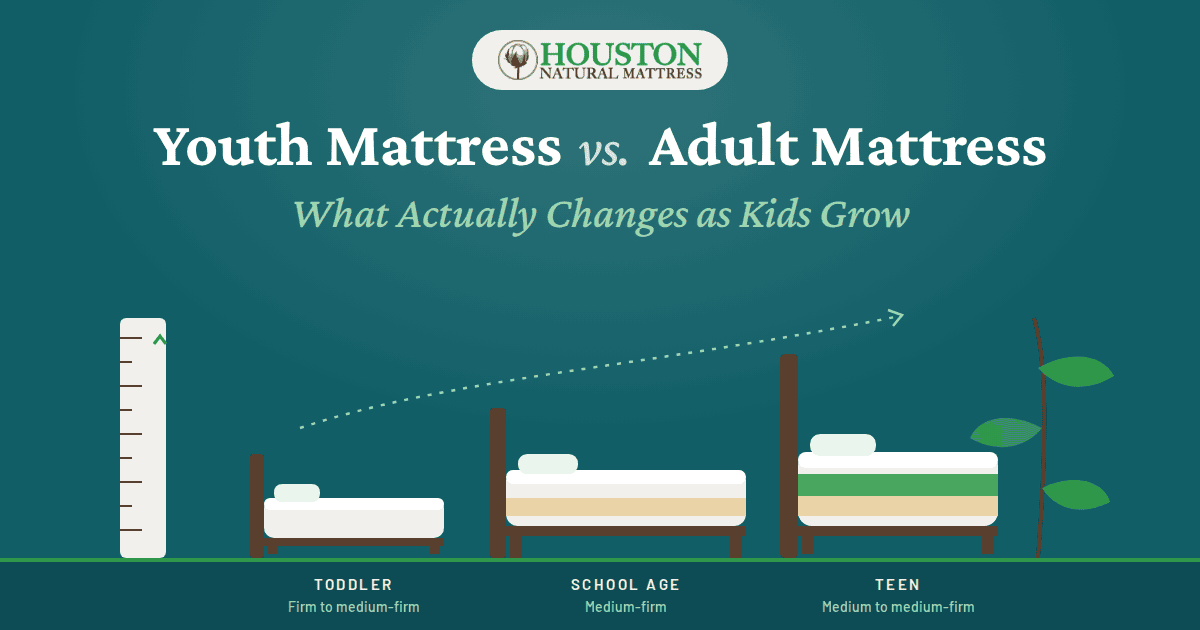
- Firmness converges with age. Toddlers generally do best on firmer surfaces, school-age kids on medium-firm, and teens near adult medium. It is a gradual shift, not a single switch.
- Judge thickness by fit and construction, not inches alone. Many youth mattresses run about 5 to 8 inches, but a well-built thinner bed can outperform a poorly built thick one. For bunk beds, follow the frame maker’s maximum thickness so the guardrail stays safely above the surface.
- Durability matters more, not less. Kids are hard on a mattress and sleep more hours on it than they ever will as adults, so build quality and materials count.
- Materials matter most at this age. A child spends a large share of a growing life asleep, which is the strongest case for choosing low-emission, natural, breathable materials.
Why a Plush Bed Often Does Not Suit a Young Child
For a young child, a mattress that feels too firm to you is often about right for them, and the reason is worth understanding.
Firmness is felt through body weight.
An adult sinks into a soft comfort layer and it cradles them. A lighter child does not press into that layer the same way, so the plush bed that feels luxurious to you can feel like resting on top of the surface to them, with little of the give doing useful work. That does not mean a child needs an unusually hard mattress. It means a deeply soft bed tends to offer less real support than it appears to, so a supportive medium-firm is usually the safer starting point.
For infants, the guidance is firmer and more clear-cut: a firm, flat surface reduces the risk of suffocation and entrapment, and that is a safety recommendation, not a preference. After infancy it becomes a judgment call, weighed against a child’s weight, sleep position, and how the mattress is built. One point holds throughout: softness is easy to add later with a topper, while a bed that is too soft cannot be made supportive after the fact.
The Firmness Ladder by Age
Firmness is not one setting for all of childhood; it shifts as a child gains weight. The starting points below are common industry guidance, not a pediatric standard, and worth adjusting to the individual child. Firmness labels are not standardized either, so one maker’s “medium-firm” can differ from another’s.
| Age range | Common starting point | Why it tends to work |
| Toddler, 2 to 5 | Firm to medium-firm | A lighter body gets little support from a very soft surface, so most guidance leans firmer here. |
| School age, 6 to 12 | Medium-firm | Heavier and more active, with enough cushion for the side-sleeping many kids prefer. |
| Teen, 13+ | Medium to medium-firm | Preferences begin to match adults, adjusted for weight and sleep position. |
When a child is between stages, size the firmness to their weight and sleep position rather than age alone. A heavier ten-year-old may be ready for a bit more give; a small, light teen who sleeps on their side may want it slightly softer.
Size, Thickness, and Durability
Adults tend to buy thick, tall mattresses, and children usually do not need that much. Many youth mattresses run about 5 to 8 inches, which suits a lighter body and keeps the surface at a manageable height. But thickness alone does not determine support: a well-built thinner mattress can outperform a poorly built thick one, so judge support by construction and materials, not by the number of inches.
For a bunk or loft bed, thickness becomes a genuine safety matter. Follow the bed manufacturer’s stated maximum mattress thickness, which is set so the guardrail stays at least five inches above the top of the mattress. A mattress that pushes the surface too high defeats the guardrail, however comfortable it is.
Durability also deserves more attention for a child’s bed, not less. A child’s mattress absorbs jumping, spills, and years of hard use, so a cheap foam bed that breaks down in three years is a false economy when a well-made mattress can last from the toddler years toward the teens. A waterproof, breathable protector helps at every age.
The Case for Natural Materials in a Child’s Room
If materials ever matter, they matter most for a child, and off-gassing is the clearest reason why. New mattresses can release chemical emissions from certain foams, adhesives, fabrics, and flame-barrier materials, which in some conventional beds include added flame-retardant chemicals or a fiberglass layer. Some of these emissions produce the familiar “new mattress” odor, while others have little or no smell, so odor is not a reliable measure of how much a mattress emits or whether it matters. For an adult, the usual advice is to air it out and move on; for a child, the calculation is different.
Why chemical emissions matter more for kids
Children are not just small adults where chemical exposure is concerned. They breathe faster and take in more air relative to their body weight, so proportionally they inhale more of whatever is in the room. Their lungs are still growing after birth, their organ and immune systems are still developing, and developing airways are more sensitive to irritants. A child also spends more time on the mattress: a young child may sleep ten to fourteen hours a day, much of it with the face close to the surface.
What the studies show about the breathing zone
That last point matters more than it sounds. Research on crib mattresses has found chemical concentrations in the infant’s breathing zone, right at the surface, running roughly two times the levels in the surrounding room air, and simulated body heat can increase emissions from polyurethane foam. These emissions are not one substance: recent testing of children’s mattresses detected both volatile and semivolatile compounds, including phthalates and flame-retardant chemicals, so “VOCs and SVOCs”.
How natural materials help
Natural materials are a straightforward way to reduce that chemistry. Natural latex, wool, and organic cotton are breathable and, when kept clean and dry, tend to resist dust mites and mold better than dense synthetic foams, though moisture, covers, and construction all play a part. Wool is worth a special mention, because it resists fire well enough that many certified organic mattresses rely on it to meet flammability rules without added flame-retardant chemicals.
There are two important limits. A natural label is a strong clue, not an automatic guarantee: it does not by itself confirm the absence of added flame retardants, and even natural materials give off a mild, natural odor at first. The way to be sure about a specific mattress is finished-product emissions testing from a credible third party, most commonly GREENGUARD Gold, which applies lower emission limits suited to sensitive indoor environments such as children’s rooms and schools. Material choice narrows the field; certification confirms it.
Common Questions About Youth Mattresses
Can a child just use an adult mattress? Often yes, especially an older child or teen, as long as the firmness suits their lighter frame. The caution is that a deeply plush adult mattress bought for a young child can feel too soft to give them useful support. Match firmness to the child, not to what feels comfortable to you.
When should we move a child to a twin or full mattress? Children usually move to a twin or full once they have outgrown the toddler bed, can climb out of it, or need more room. The timing varies, so focus on safety, available space, and how long you want the next mattress to last. Buying a full or a Twin XL leaves room for growth spurts and can save a purchase later.
What firmness is best for a teenager? Teens land close to adult preferences: medium to medium-firm, adjusted for weight and sleep position. Lighter teens and side sleepers may want it a touch softer; heavier or stomach sleepers, a touch firmer.
Checklist for Choosing a Youth Mattress
- Lean supportive, not plush. For most kids after infancy, a supportive medium-firm is a safer default than a deeply soft bed, adjusted for weight and sleep position.
- Remember softness is fixable, firmness is not. You can add cushion to a firm bed with a topper, but you cannot make a too-soft bed supportive after the fact.
- Judge thickness by fit and build. Many youth mattresses run 5 to 8 inches, but support comes from construction, not inches. For bunks, follow the frame maker’s maximum thickness so the guardrail stays safely above the surface.
- Plan for growth. A full or a Twin XL leaves room for growth spurts, so you are not buying twice.
- Prioritize low-emission, clean materials. Favor natural latex, wool, and organic cotton, and look for finished-product emissions certification for a room a child breathes in for years.
- Protect it. Add a waterproof, breathable protector, which matters at every age.
- Buy for durability. Choose a build that will survive years of hard use rather than the cheapest option.
Bring the Kids and Try a Few in Person
Firmness is hard to judge from a description, and harder still to guess for a child. At Houston Natural Mattress on Kirby Drive, we carry natural and organic youth and adult mattresses, along with a certified organic baby and youth selection. Bring the kids, let them lie down, and we will help you match firmness to age and weight rather than guesswork.
Serving the Greater Houston Metro including the Heights, Rice Village, River Oaks, Upper Kirby, Montrose, and the Museum District and beyond. Visit our Kirby Drive showroom and feel the difference for yourself.
Address: 6111 Kirby Dr, Houston, TX 77005
Phone: (832) 582-6324
Website: houstonnaturalmattress-opti.blz.au
Hours:
Mon: 10 AM – 7 PM
Tue: 10 AM – 7 PM
Wed: 10 AM – 7 PM
Thu: 10 AM – 7 PM
Fri: 10 AM – 7 PM
Sat: 10 AM – 5 PM
Sun: 12 PM – 6 PM
Amanda is a wellness-focused writer passionate about sustainable living and sleep science. She specializes in natural mattresses and eco-conscious bedding, exploring how healthier materials and mindful choices can transform the way we rest. With a graduate degree in Nursing from Vanderbilt University and professional membership in the American College of Lifestyle Medicine, Amanda strives to promote the pillars of restorative sleep and the avoidance of toxic substances. She empowers readers to make informed decisions that benefit both personal well-being and the planet. Outside of her research on organic sleep solutions, Amanda enjoys forest hikes, sipping herbal tea, and embracing minimalist design.